
Australia's First Terror Attack
Terrorism has always been an imported phenomenon.

On Sunday evening, a father and son opened fire on a Hanukkah celebration at Bondi Beach, murdering at least fifteen people in what authorities have declared an Islamic State-inspired terrorist attack. It is the deadliest terrorist incident in Australian history.
But it is not the first.
In the wake of the Bondi shooting, Australian commentator ‘Auspill’ brought a forgotten piece of history back into public discourse — and pointed out a pattern that deserves wider attention. It starts with an episode from 110 years ago.
The Battle of Broken Hill
On New Year’s Day 1915, some 1,200 men, women and children boarded a train of open ore wagons in the outback mining town of Broken Hill, bound for the annual picnic at nearby Silverton. Just outside town, two men emerged from behind rocks on the embankment. They were dressed in turbans and khaki, and they carried rifles. They opened fire on the completely exposed picnickers.
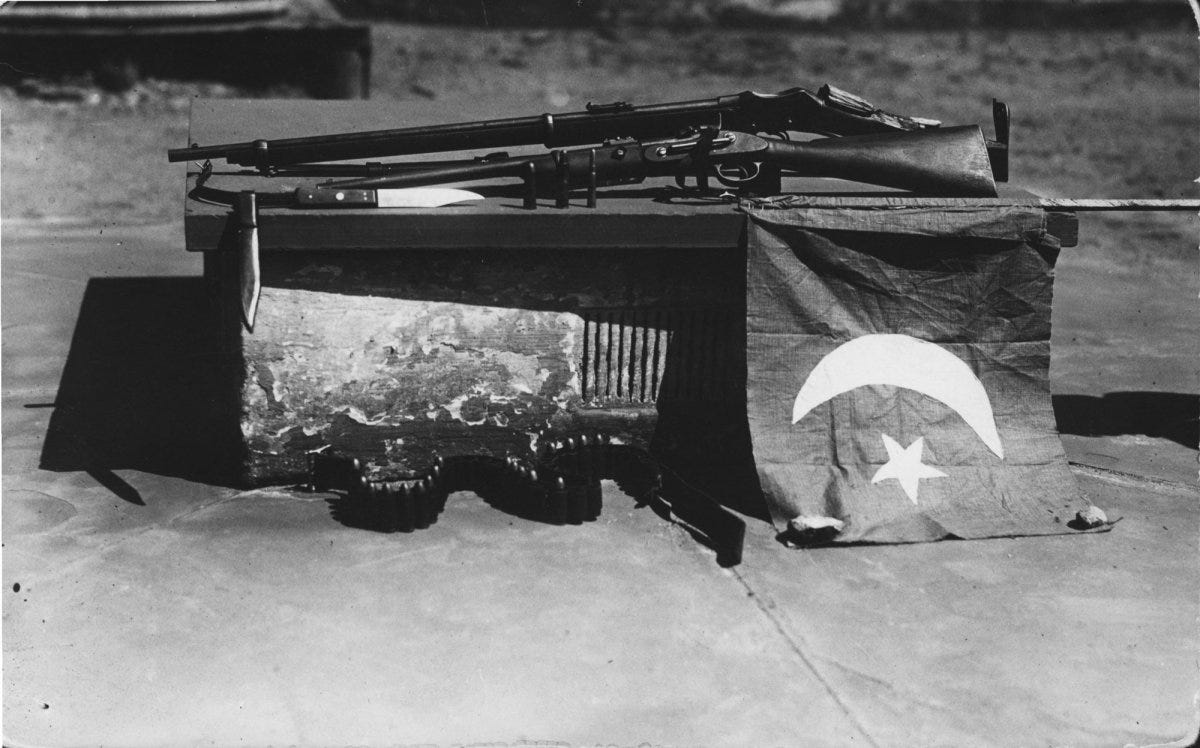
Four people were killed, seven wounded. The shooters were Gool Badsha Mahomed, a former cameleer turned ice-cream vendor, and Mullah Abdullah, a halal butcher — both Afghan immigrants who had entered the country prior to Australia’s institution of the Immigration Restriction Act of 1901. They had fashioned a homemade Turkish flag, which they flew from Gool’s ice-cream cart as they set out that morning. They left suicide notes. Gool’s read:
“I must kill you and give my life for my faith, Allāhu Akbar.”
The men were responding to a call from the other side of the world. In November 1914, the Ottoman Sultan Mehmed V had proclaimed a jihad against Britain and her allies, urging Muslims everywhere to rise up and strike at the infidel. Almost nobody listened. But in a dusty mining town 12,000 miles from Constantinople, two men heard the call.
After a ninety-minute gun battle with police, soldiers, and local rifle-club members, both attackers were killed. A letter bearing the seal of the Sultan was found in Gool’s waist-belt.
A Recurring Pattern
The Battle of Broken Hill was Australia’s first Islamic terrorist attack. It occurred in a period when the new Commonwealth was still defining its national identity — an identity that included the White Australia Policy that would have prevented the attack if instituted earlier.
What followed was roughly sixty years free from terror. Between Broken Hill in 1915 and September 1972, there is no recorded terrorist attack on Australian soil. This terror-free era ended as the White Australia Policy did, when Sydney was wracked by the bombing of the Yugoslav General Trade and Tourist Agency by Croatian separatists.
The pattern since then is consistent.
Terrorism in Australia is almost always imported ethnic and religious conflict. Croatian separatists bombing Yugoslav offices. Armenian nationalists attacking Turkish consulates. And, overwhelmingly, jihadists waging holy war on Australian soil. These are not Australian grievances. They are foreign wars, foreign hatreds, foreign ideologies — brought here by immigration and allowed to fester under the protective umbrella of “multiculturalism.”
Since 2014, Australia has experienced nine Islamic State-inspired attacks and disrupted dozens more plots. Every single one was carried out by Muslim immigrants or their children.
With the unravelling of late-multiculturalism, the pattern Broken Hill established has only intensified.
Bondi
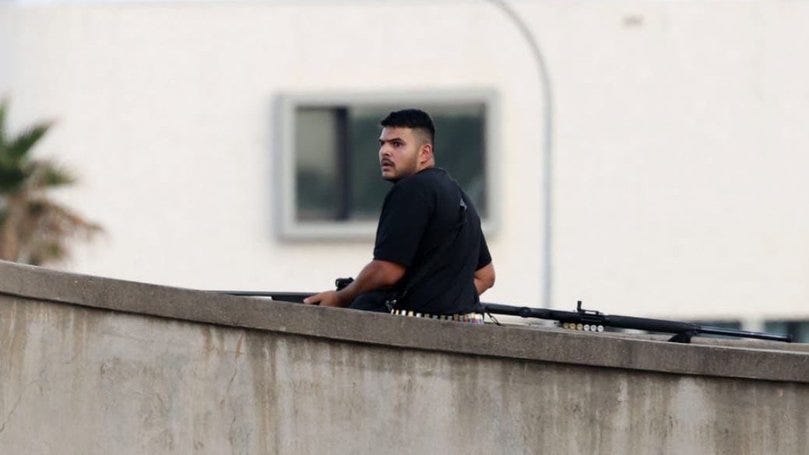
On Sunday night, a father and son who had pledged allegiance to Islamic State murdered at least fifteen people at Bondi Beach. The father immigrated in 1998. The son was born here — radicalised into the same ideology that motivated two Afghan cameleers 110 years ago.
“Globalise the intifada” has echoed through Australian streets for over a year now. The slogan’s defenders insist it merely means “uprising” in the abstract. But intifada, in living memory, means suicide bombings, shootings, stabbings. To “globalise” it means to bring that violence everywhere — including to Bondi Beach.
When you chant for global holy war, you should not be surprised when someone takes you at your word.
The rhetoric that enabled this is not merely foolish — but suicidal. A nation that imports large numbers of people from cultures hostile to its own, that celebrates this as a moral good, whilst suppressing any discussion of the consequences, and that allows foreign calls to holy war to echo through its streets — such a nation has abandoned the most basic duty any government owes its citizens: protection.
The bureaucrats who dismantled Australia’s immigration controls, the academics who constructed the ideology of multiculturalism, the journalists who enforced the taboo against discussing its costs, the protest organisers who chanted “globalise the intifada” — none of them will be automatically held accountable for Bondi Beach.
None of them ever are, unless we hold them accountable. Relentlessly. Endlessly.
The pattern could not be clearer, its evidence spans a century. Will Australia finally confront it and chart a safer path forward, or simply light another candle and merely hope the next attack never comes?